
Introduction
If you searched for the sinch meaning in text, here is the simple answer. If you have come across the word “sinch” and are not sure what it means, you are not alone. The sinch meaning is slightly unusual because the word sits between two worlds: it is a less common spelling of “cinch,” which can mean either a horse’s saddle strap or something that is very easy to do, and it is also the name of a well-known technology company. Which meaning applies depends entirely on context.
In this guide, we explain the sinch meaning in plain English. You will learn where the word comes from, how it is used as a saddle strap and as a term for an easy task, when to use “sinch” versus “cinch,” and what the Sinch company does. We finish with example sentences and answers to the most common questions. Once you grasp the sinch meaning, you will spot it easily in writing and conversation.
Related meanings: Ight Meaning in Texting: Definition & Examples, SMTH Meaning in Texting: Definition & Examples, and OW Meaning in Text: Chat & Gaming Senses, Made Simple.
Table of Contents
Sinch Meaning in Text: Definition and Key Facts
“Sinch” is a variant spelling of “cinch.” It can mean a saddle strap that holds a saddle on a horse, or, figuratively, something that is very easy to do or a sure thing. In everyday writing, “cinch” is the standard spelling and “sinch” is rare. In modern business news, “Sinch” most often refers to Sinch AB, a Swedish cloud communications company formerly known as CLX Communications. Keeping the sinch meaning straight helps you pick the right spelling every time. In short, the sinch meaning in text depends on the context around it.
Sinch Meaning and Origin: Where Does It Come From?
The word behind “sinch” is “cinch,” which comes from the Spanish word “cincha,” meaning a girdle or belt. Spanish-speaking horsemen in the Americas used a “cincha” as the strap that secures a saddle, and English speakers in the American West borrowed the word in the 1800s, adapting the spelling to “cinch” (and occasionally “sinch”).
The figurative meaning grew out of the literal one. A saddle cinch holds everything firmly in place, so a task that is a “cinch” is one that is firmly under control, easy to handle, and almost guaranteed to succeed. This is the same path many concrete words take as they become idioms: the physical image stays, and the meaning stretches. You can see how the term is categorized on Wikipedia, where “a cinch (alternate spelling sinch)” is listed as a type of saddle girth.
Sinch as a Saddle Strap
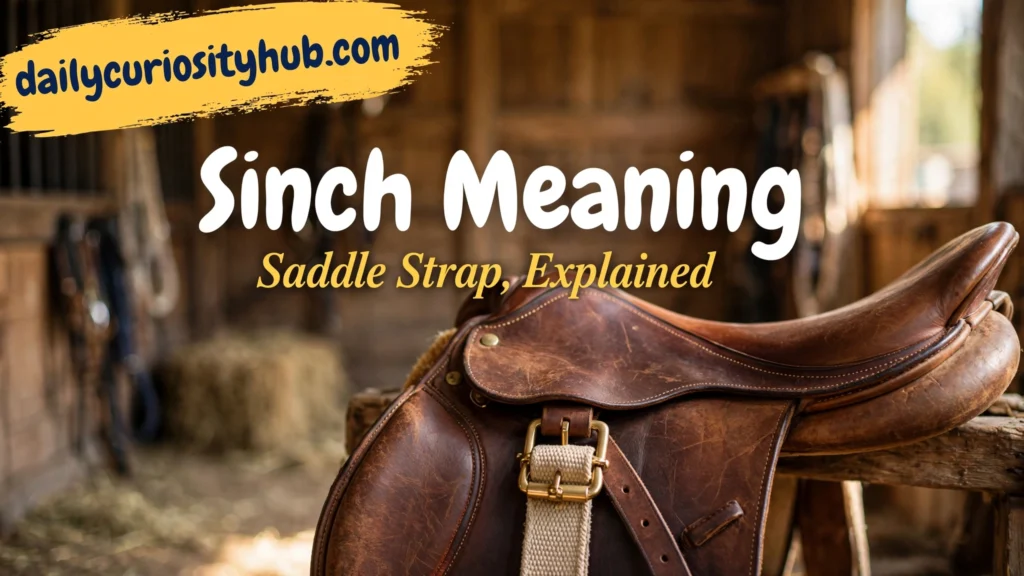
In its oldest sense, a sinch is a saddle girth: the wide strap that runs under a horse’s belly and holds the saddle in place. Ranchers and riders in the western United States still use the word in this sense, and you may hear phrases like “tighten the sinch” or “check the sinch” before a ride.
A sinch is usually made of leather, mohair, or a synthetic cord, and it connects to the saddle through metal rings. If it is too loose, the saddle slips; if it is too tight, the horse is uncomfortable. Riders “sinch up” a horse, meaning they tighten the strap before mounting. The verb form appears in western writing as “to sinch,” as in “he sinched the saddle before the long ride.”
Because the standard spelling “cinch” is far more common in modern dictionaries, writers describing horse tack today almost always use “cinch.” The spelling “sinch” survives mainly in older western texts and regional speech.
Sinch as an Easy Task or a Sure Thing
The figurative sense of “sinch” is the one most people meet in everyday language. When something is a “sinch,” it is very easy to do or a sure thing, something you can count on with almost no effort or risk.
You will hear it in sentences like “that test was a sinch” (it was easy), “the home team is a sinch to win” (they are almost certain to win), or “getting a reservation will be a sinch” (it will take no trouble). In this sense, “sinch” and “cinch” are fully interchangeable, though “cinch” is the spelling you will find in dictionaries.
This usage is common in American English and has been around for more than a century. It keeps the flavor of the original saddle strap: something held tight and secure, nothing left to chance. The sinch meaning has stayed consistent in this figurative use.
Sinch vs Cinch: Which Spelling Should You Use?
In almost every situation, use “cinch.” It is the standard spelling listed in dictionaries, and readers will recognize it immediately in both the saddle-strap sense and the easy-task sense.
Reserve “sinch” for these cases:
Using “sinch” in general writing is not wrong in a strict sense, since it is recorded as a variant, but it will look like a typo to most readers. When in doubt, “cinch” is the safer choice.
Sinch the Company
In business and technology news, “Sinch” almost always means Sinch AB, a Swedish cloud communications company headquartered in Stockholm. Founded in 2008 as CLX Communications, the company rebranded as Sinch in 2019, choosing a name that suggests simplicity and ease, a nod to the word’s “easy” meaning.
Sinch provides messaging, voice, and video communication services that businesses use to reach their customers. The text-message alerts from your bank, the verification codes sent when you log in to an app, and the appointment reminders from your doctor often travel through platforms like Sinch’s. The company is publicly traded on the Stockholm stock exchange under the ticker SINCH and operates in more than 60 countries.
So if you read a headline like “Sinch reports strong quarterly growth,” it is about the company, not about saddles or easy tasks. Capitalization and context make the difference.
Examples of Sinch in Sentences
These sentences cover all three uses — the saddle strap, the easy task, and the company — so the context tells you which sinch is meant.
Frequently Asked Questions
What is the sinch meaning in text, and is it a real word?
Sinch meaning: “sinch” is recorded as a variant spelling of “cinch.” It is rare in modern writing, where “cinch” is the standard spelling, but it appears in western American texts and as the name of the company Sinch AB.
What is the difference between “sinch” and “cinch”?
They mean the same things: a saddle strap or an easy task. “Cinch” is the standard, dictionary-listed spelling. “Sinch” is a less common variant, and today it is mostly seen in the company name Sinch AB.
Where does the word “sinch” come from?
It comes through “cinch,” from the Spanish word “cincha,” meaning a girdle or belt. English speakers in the American West borrowed it in the 1800s to name the strap that holds a saddle on a horse.
What does “it’s a sinch” mean?
“It’s a sinch” means something is very easy to do or a sure thing. For example, “this recipe is a sinch” means the recipe is simple and almost impossible to get wrong.
What is the Sinch company?
Sinch AB is a Swedish cloud communications company, headquartered in Stockholm and formerly known as CLX Communications. It provides messaging, voice, and video services that businesses use to communicate with customers, and it is listed on the Stockholm stock exchange.
Conclusion
The sinch meaning comes down to context. “Sinch” is a variant of “cinch,” meaning a saddle strap or, figuratively, something very easy to do or a sure thing. In everyday writing, “cinch” is the spelling to use, while “Sinch” with a capital S usually points to the Swedish communications company. Knowing all three uses means you will never be confused when the word shows up, whether on a ranch, in a review, or in a business headline. Now that you know the sinch meaning, you can use it with confidence. Keep that in mind, and the sinch meaning in text will be easy to spot in any message.